Seminar Dr Denise Arico
When plants are exposed to strong hyperosmotic stress, water exits the cell leading to plasmolysis, where the plasma membrane detaches partially from the cell wall. This detachment reveals discrete sites, where the plasma membrane remains connected to the wall. To identify the molecular components underlying this physical linkage, we conducted a targeted screen of Arabidopsis candidate proteins (Fig 1). Among them, overexpression of the receptor-like kinase LecRK-I.9 significantly increased the density of plasma membrane–wall connections in Nicotiana benthamiana pavement cells. We found that the extracellular lectin domain of LecRK-I.9 is required for establishing these connections. Under hyperosmotic conditions, LecRK-I.9 forms immobile clusters, exhibiting an asymmetric distribution across cell surfaces in the epidermis of different organs in Arabidopsis. Deletion of the lectin domain increases cluster mobility and abolishes this asymmetry, indicating that the lectin domain regulates LecRK-I.9 spatial distribution at the plasma membrane (Fig 2). We are currently determining whether the lectin domain binds to specific microdomains within the wall and at assessing whether LecRK-I.9 overexpression modulates wall deformation during hyperosmotic stress. We are also evaluating the tolerance of LecRK-I.9 overexpressing lines to low water potential and drought conditions that challenge the integrity of the plasma membrane–wall continuum. 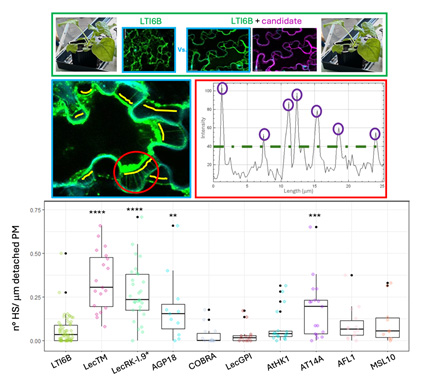
Figure 1. Screen for proteins promoting plasma membrane – cell wall connections. Transient transformation of N. benthamiana followed by plasmolysis of pavement cells with glycerol 10%, and quantification of density of Hechtian strands labeled with LTI6B-mCitrine. Boxplot showing the density of Hechtian strands (HS), expressed as number of HS per m of detached plasma membrane (PM), for each tested candidate compared to the control LTI6B. Statistical significance was determined using the Kruskal–Wallis test followed by Dunn’s post hoc test with Benjamini–Hochberg correction. ****p-values < 10-5, ***p-values < 0.0002, **p-values < 0.003.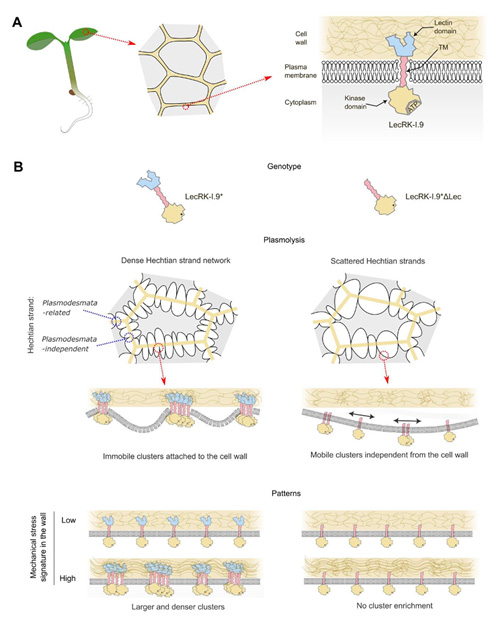
Figure 2. Model: LecRK-I.9 acts as a molecular glue, anchoring Hechtian strands and reflecting the mechanical stress signature in the wall. A. Description and localization of LecRK-I.9. B. Summary of the results with LecRK-I.9* and LecRK-I.9*Lec. LecRK-I.9*: Legume-type lectin Receptor-like kinase I.9. * 5 alanine substitutions at positions 350aa – 354aa within the ATP binding motif. LecRK-I.9*Lec: LecRKI.9* without lectin (244aa at positions 22aa – 265aa).
Denise Arico, "Méchanotransduction et développement" MECANODEVO, RDP, ENS de Lyon
Invitation: Grégory Mouille, "Cell to Cell Adhesion and Communication" ACCI team
Seminar in connection with the research developed at the Institute Jean-Pierre Bourgin for Plant Sciences.
Back
