Seminar IJPB/ SPS Dr Thanvi Srikant
The effect of ploidy and genetic differentiation on chromatin architecture: insights from Arabidopsis arenosa - Thursday 25 June 2026 9:30 am, INRAE, Versailles
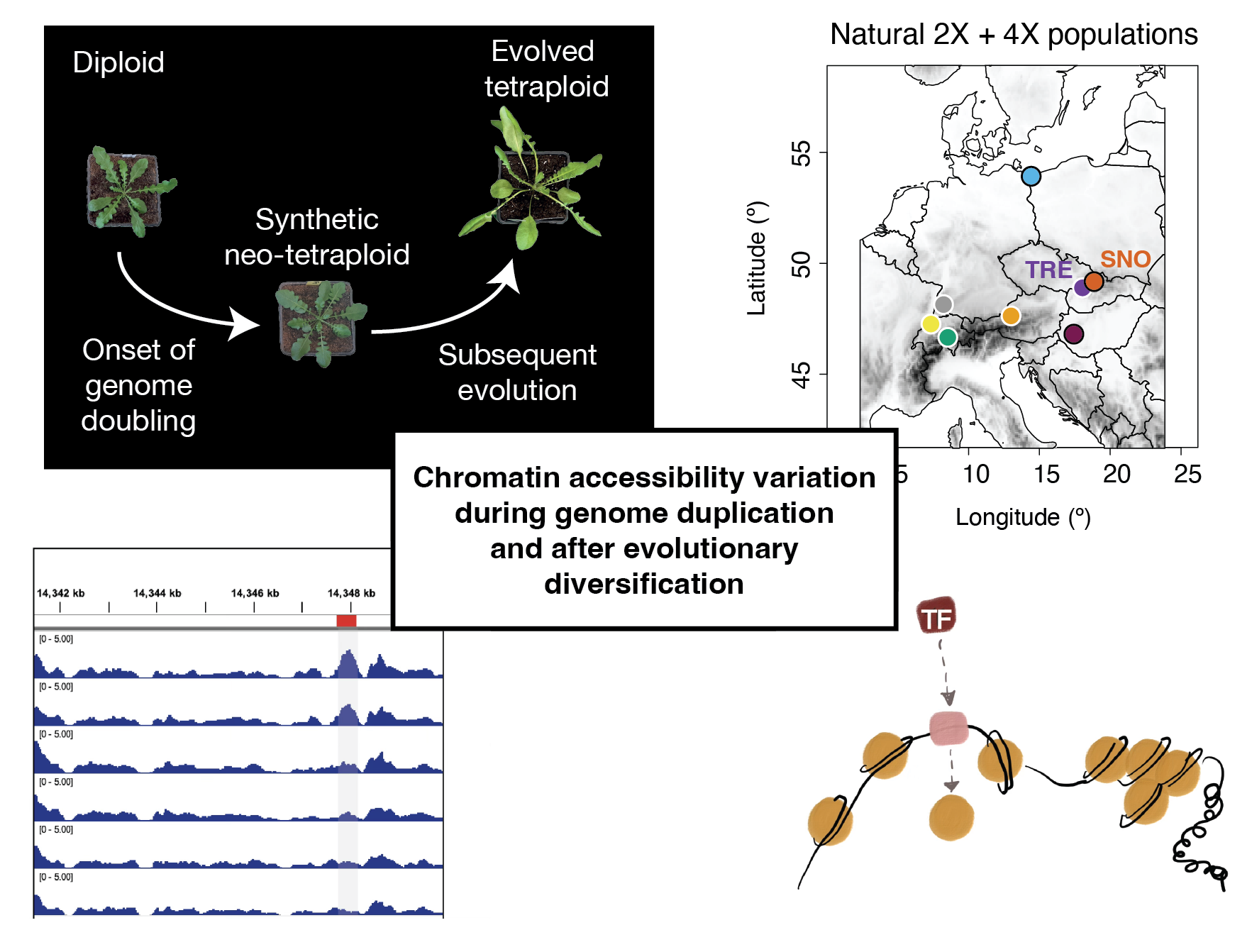
My research focuses on understanding plant adaptation and natural variation through the lens of epigenetics and epigenomics. As a postdoctoral fellow in Prof. Kirsten Bomblies' group at ETH Zurich, I investigated how chromatin accessibility and transcription change during the evolution of polyploidy in Arabidopsis arenosa, an emerging model system for adaptation genomics. This species comprises diploid and naturally occurring autotetraploid populations sharing a single origin (~30,000 years ago). Following the ancestral genome doubling event, autotetraploid populations underwent extensive niche expansion and show signatures of positive selection in several genes, including multiple chromatin remodeller genes. This raised the question – could chromatin architecture be particularly affected by the onset of genome doubling? Did it change further during subsequent intraspecific diversification?
To address these questions, I profiled chromatin accessibility (ATAC-seq), transcription (RNA-seq), and genetic variation across three diploid populations, two synthetic neo-tetraploid families derived from the ancestral diploid, and five evolved tetraploid populations spanning diverse genetic lineages. Across a total of 34 individuals from 10 populations, 7,032 differentially accessible chromatin regions (dACRs), 9,669 differentially expressed genes, and over 9 million SNPs were identified. In my talk, I will discuss how the chromatin accessibility landscape of A. arenosa varies with ploidy and population of origin, how it correlates with proximal gene expression and transposable elements, and its striking association with genome-wide SNPs, including genetic variants at chromatin remodeller loci.
Finally, I will introduce my new research team at the Institute of Integrative Biology, ETH Zürich, where we will examine genome–epigenome interactions during high-altitude adaptation in the alpine plant Arabis alpina.
Thanvi Srikant, Institute of Integrative Biology -IBZ, ETH Zurich, Switzeland
Invitation: Adrian Gonzalo Sanchez,"Meiosis Mechanisms" MeioMe team
Seminar in connection with the research developed at the Institute Jean-Pierre Bourgin for Plant Sciences.
To address these questions, I profiled chromatin accessibility (ATAC-seq), transcription (RNA-seq), and genetic variation across three diploid populations, two synthetic neo-tetraploid families derived from the ancestral diploid, and five evolved tetraploid populations spanning diverse genetic lineages. Across a total of 34 individuals from 10 populations, 7,032 differentially accessible chromatin regions (dACRs), 9,669 differentially expressed genes, and over 9 million SNPs were identified. In my talk, I will discuss how the chromatin accessibility landscape of A. arenosa varies with ploidy and population of origin, how it correlates with proximal gene expression and transposable elements, and its striking association with genome-wide SNPs, including genetic variants at chromatin remodeller loci.
Finally, I will introduce my new research team at the Institute of Integrative Biology, ETH Zürich, where we will examine genome–epigenome interactions during high-altitude adaptation in the alpine plant Arabis alpina.
Thanvi Srikant, Institute of Integrative Biology -IBZ, ETH Zurich, Switzeland
Invitation: Adrian Gonzalo Sanchez,"Meiosis Mechanisms" MeioMe team
Seminar in connection with the research developed at the Institute Jean-Pierre Bourgin for Plant Sciences.
Back
