The CSS group studies the developmental and metabolic processes that drove seed evolution
The evolution of the seed habit contributed profoundly to the diversification and ecological success of seed plants, ultimately shaping modern terrestrial ecosystems and, indirectly, human society. We revisit seed evolution from a perspective that has been largely overlooked in recent years, despite its early formulation in 1851 by Wilhelm Hofmeis
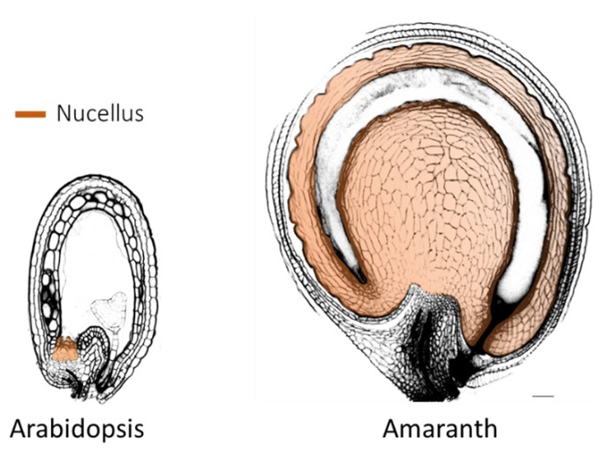 ter, one of the founding fathers of plant biology. The nucellus tissue, responsible for female sporogenesis, evolved from a dehiscent state, as in non-seed plants where spores are released, to an indehiscent state in seed plants, where spores are retained. This change in nucellar cell fate unequivocally marked the evolution of seed plants. Spore retention required the accommodation of the developing female gametophyte within maternal tissues. To facilitate this process, the nucellus evolved the capacity to create space through the process of cell elimination, which leads to the complete removal of a cell, including its cell wall. Following fertilization of the gametophyte, the nucellus orchestrates the spatial organization of the seed, giving rise to species-specific seed architectures. In gymnosperms, which undergo a single fertilization event to give rise to a zygotic embryo, the nucellus is further eliminated by the female gametophyte, the main storage tissue. In angiosperms, which produce two fertilization products, embryo and endosperm, the nucellus is either consumed by the endosperm (endospermic seeds, such as cereals and Arabidopsis) or retained (perispermic seeds, such as amaranth) to store nutrients at the expense of the endosperm.
 The evolution of zygote-maternal cohabitation in seeds requires a complex signaling network to relay fertilization cues, promote the development of a maternal milieu supportive of embryogenesis, and ensure precise spatiotemporal coordination of growth between maternal and zygotic compartments. The seed maternal tissues are not directly involved in fertilization but respond to it through a dedicated signaling pathway that communicates the occurrence of fertilization. Zygotic-maternal communication must also guarantee the balanced allocation of resources to the progeny, which is fundamental to the success of reproduction. Maternal tissues must correctly sense fertilization to provision the offspring with enough nutrients to ensure its vigor while not over-depleting the parent and, thereby, endanger its survival. Therefore, a maternal checkpoint integrates information about the plant's energetic status within the pathway of maternal recognition of fertilization.
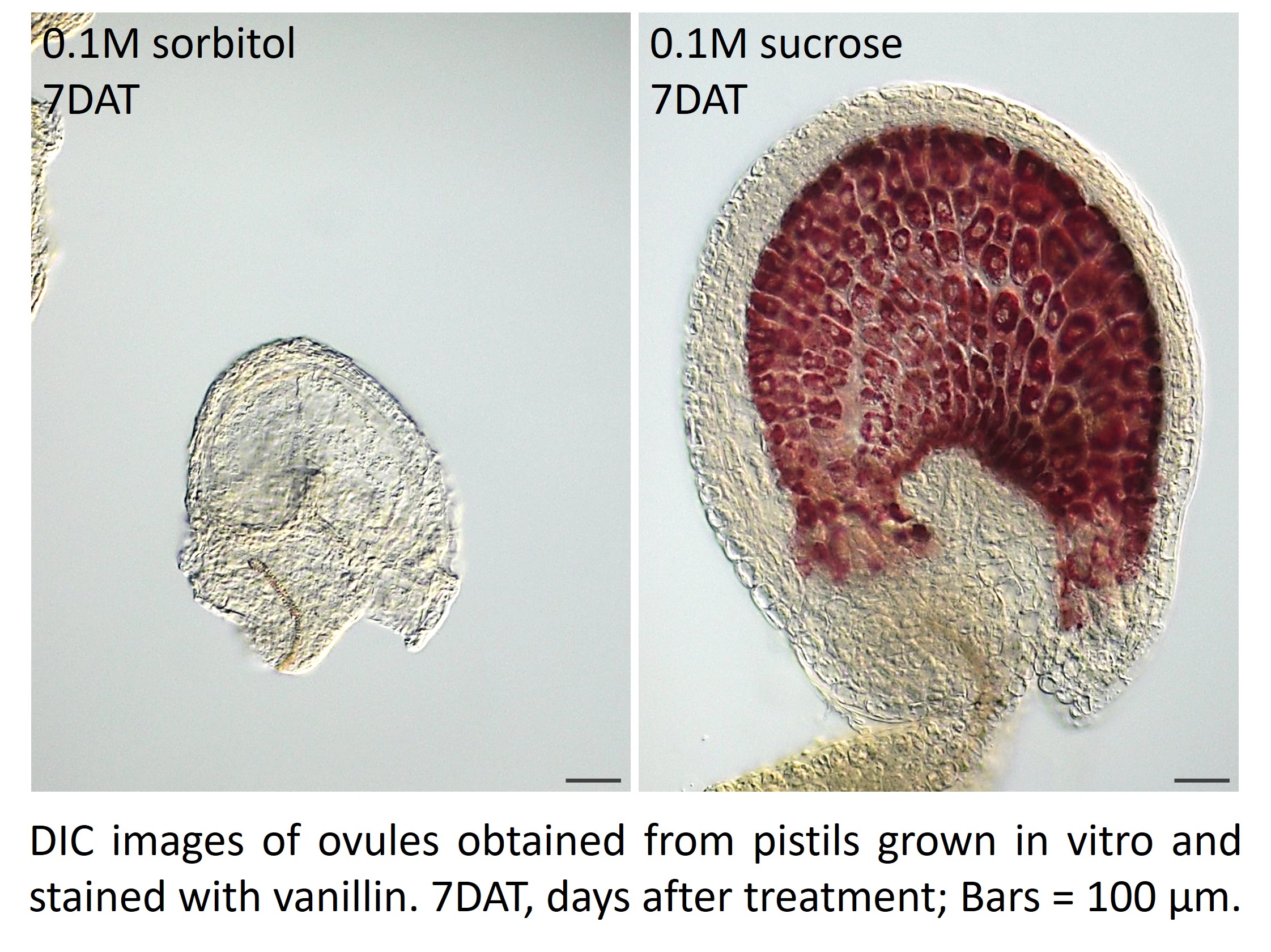
Our work focuses on the development of the nucellus as a means to address fundamental questions in seed evolution. We are particularly interested in the process of cell elimination, with a focus on cell wall dismantling and its role in shaping different seed architectures. A second major line of research concerns the communication between maternal and zygotic compartments and how these interactions shape seed structure and reproductive success across plant lineages. We place particular emphasis on how development and metabolism are integrated within shared signaling pathways that coordinate energetic status with developmental cues. We approach these questions through complementary experimental models using tools from molecular genetics, biochemistry, cell and structural biology, microscopy, and modeling, enabling an integrated understanding of these processes across molecular, cellular, and evolutionary scales.
Selected publications
1. Xu W., Iannaccone M., Gomez-Paez D.M., Choinard S., Lu J., Le Hir R., Dinant S., Kalmbach L., Feil R., Lunn J.E., Meyer C., Magnani E. (2025) Too much sugar makes plants ‘pregnant’: maternal sucrose signals fertilization in Arabidopsis seeds. bioRxiv 2025.05.16.654273.
2. Iannaccone M.*, Xu W.*, Gomez-Paez D.M., Choinard S., Maricchiolo E., Peaucelle A., Voxeur A., Haas K.T., Pompa A., Magnani E. (2026) A change in the cell wall status initiates the elimination of the nucellus in Arabidopsis. PNAS In press
3. Xu W., and Magnani E. (2023) An actin starry night regulates seed size. Nat Plants 9, 201-202.
4. Gómez-Páez D.M. and Magnani E. (2024) Confocal Imaging of Seeds. Methods in Molecular Biology. SpringerNature, 2830:93-104
5. Butel N., Qiu Y., Xu W., Santos-González J., Köhler C. (2024) Parental conflict driven regulation of endosperm cellularization by a family of Auxin Response Factors. Nature Plants, 10(6):1018-1026.
6. Xu W*., Sato H*., Bente H., Santos-González J., Köhler C. (2023) Endosperm cellularization failure induces a dehydration-stress response leading to embryo arrest. Plant Cell, 35(2): 874-888.
7. Lu J., Le Hir R., Gómez-Páez D.M., Coen O., Péchoux C., Jasinski S., Magnani E. (2021) The nucellus: between cell elimination and sugar transport. Plant Physiol, 185(2):478-490.
8. Magnani E. (2018) Seed evolution, a “simpler” story. Trends in Plant Science, 23(8):654-656.
9. Lu J., and Magnani E. (2018) Seed tissue and nutrient partitioning, a case for the nucellus. Plant Reprod, 31(3):309-317.
10. Xu W., Fiume E., Coen O., Longin C., Lepiniec L., Magnani E. (2016) Endosperm and Nucellus Develop Antagonistically in Arabidopsis Seeds. Plant Cell, 28(6):1343-60.
