Matteo Caroulle wins first prize in "PhD student poster contest" at the GS Biosphera scientific day 2026
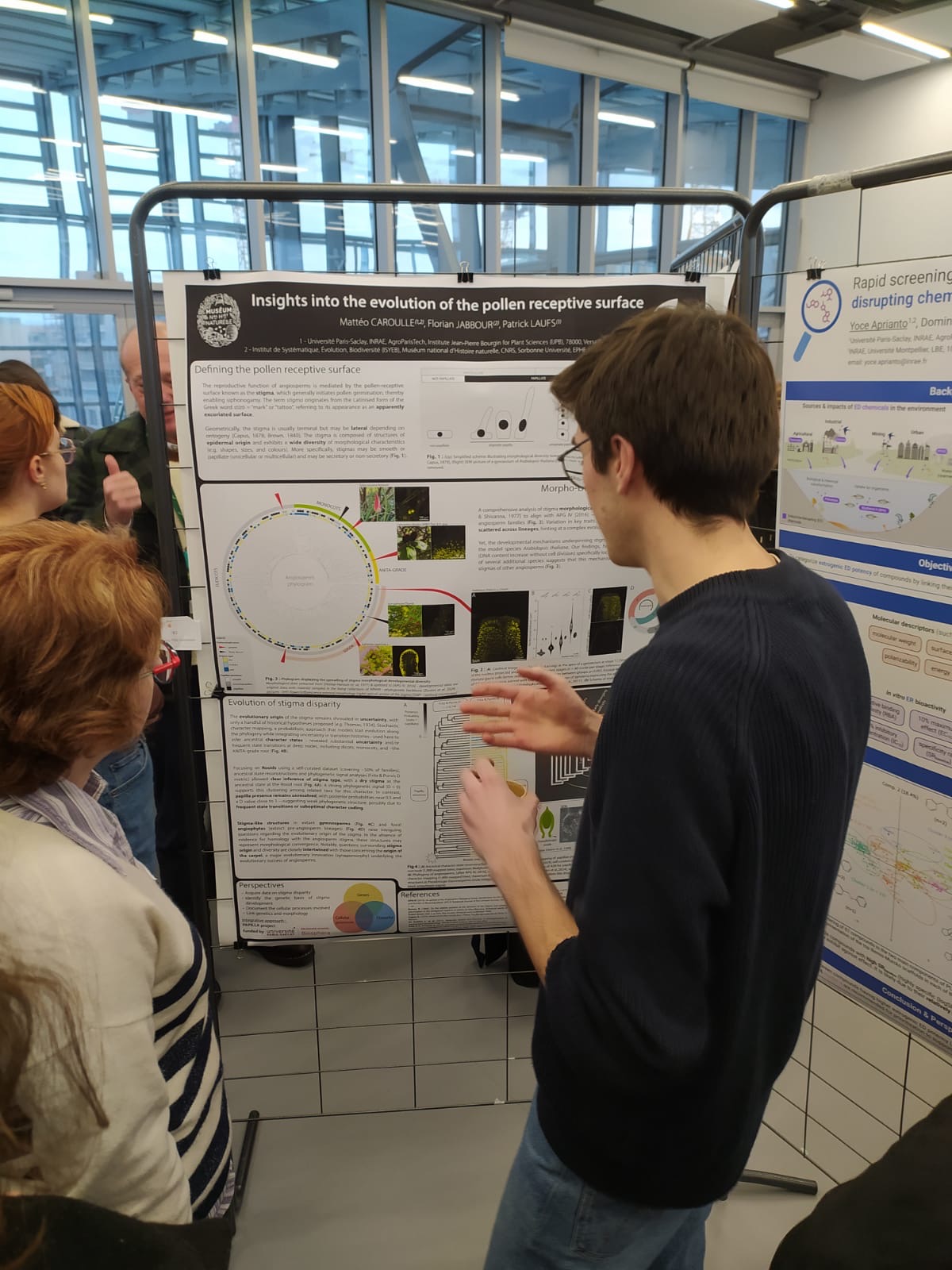
Matteo Caroulle is a PhD student in the "Transcription Factors and Architecture" FTA team, supervised by Patrick Laufs, INRAE senior scientist, and in the "Morpho-Anatomy and Development of Plants" MADP team, co-supervised by Florian Jabbour, professor at the "Muséum national d'Histoire naturelle" MNHN. His poster (see below) on the study of pistil evolution received this award at the GS Biosphera scientific day 2026, chosen from among a dozen posters submitted to a vote by participants.
PhD Project – Evolution, Development, and Genetics of Carpels in Angiosperms
Angiosperms are distinguished by their flower, at the centre of which lies the gynoecium—a structure composed of one or more carpels, which enclose the ovules and later the seeds after fertilisation. While most carpels share a common architecture (ovary, style, stigma), their morphological diversity is vast, arising from variable combinations of number, position, degree of fusion, and shape. The developmental mechanisms and molecular actors involved in gynoecium formation are beginning to be elucidated, particularly in model species such as Arabidopsis thaliana. However, the different components of the gynoecium’s architecture have not received equal attention. By integrating genetics, development, and evolution, this evolutionary botany PhD project aims to unravel the origins of this morphological diversity. The goal? To illuminate the evolutionary history of angiosperms across all flowering plants, using transdisciplinary approaches to understand how these structures have adapted and diversified.
Poster abstract – Insights into the Evolution of the Pollen-Receptive Surface
The stigma, the pollen-receptive surface in angiosperms, plays a crucial functional role: it is here that pollen germinates, marking the first step in fertilisation. Yet, despite its central importance, its morphological diversity and evolutionary history remain enigmatic, even in model species like Arabidopsis thaliana. To address these mysteries, we combined morphology, phylogeny, and cellular development: on one hand, by analysing a literature-derived dataset covering 45% of angiosperm families, and on the other, by studying stigma formation, revealing specific cellular mechanisms within their tissues. Our phylogenetic reconstructions suggest a complex evolutionary history. This poster lays the foundation for the PAPILLA project, a recipient of funding from GS Biosphera (Biodiversity axis), led by Patrick Laufs in collaboration with teams from Paris-Saclay University and the National Museum of Natural History (MNHN).
PAPILLA project, the teams involved
> IJPB team "Transcription Factors and Architecture" FTA
> "Génétique, Évolution et Écologie de la Morphologie Florale" GE2MorF, Institut Diversité, "Écologie et Évolution du Vivant" IDEEV
> "Morpho-Anatomy and Development of Plants" MADP, "Institut de Systématique, Évolution, Biodiversité" ISYEB, "Muséum national d'Histoire naturelle" MNHN
> POPS: The transcriptOmic Platform, "Institute of plant Sciences Paris-Saclay" IPS2
Research developed at the Institute Jean-Pierre Bourgin for Plant Sciences in collaboration.
PhD Project – Evolution, Development, and Genetics of Carpels in Angiosperms
Angiosperms are distinguished by their flower, at the centre of which lies the gynoecium—a structure composed of one or more carpels, which enclose the ovules and later the seeds after fertilisation. While most carpels share a common architecture (ovary, style, stigma), their morphological diversity is vast, arising from variable combinations of number, position, degree of fusion, and shape. The developmental mechanisms and molecular actors involved in gynoecium formation are beginning to be elucidated, particularly in model species such as Arabidopsis thaliana. However, the different components of the gynoecium’s architecture have not received equal attention. By integrating genetics, development, and evolution, this evolutionary botany PhD project aims to unravel the origins of this morphological diversity. The goal? To illuminate the evolutionary history of angiosperms across all flowering plants, using transdisciplinary approaches to understand how these structures have adapted and diversified.
Poster abstract – Insights into the Evolution of the Pollen-Receptive Surface
The stigma, the pollen-receptive surface in angiosperms, plays a crucial functional role: it is here that pollen germinates, marking the first step in fertilisation. Yet, despite its central importance, its morphological diversity and evolutionary history remain enigmatic, even in model species like Arabidopsis thaliana. To address these mysteries, we combined morphology, phylogeny, and cellular development: on one hand, by analysing a literature-derived dataset covering 45% of angiosperm families, and on the other, by studying stigma formation, revealing specific cellular mechanisms within their tissues. Our phylogenetic reconstructions suggest a complex evolutionary history. This poster lays the foundation for the PAPILLA project, a recipient of funding from GS Biosphera (Biodiversity axis), led by Patrick Laufs in collaboration with teams from Paris-Saclay University and the National Museum of Natural History (MNHN).
PAPILLA project, the teams involved
> IJPB team "Transcription Factors and Architecture" FTA
> "Génétique, Évolution et Écologie de la Morphologie Florale" GE2MorF, Institut Diversité, "Écologie et Évolution du Vivant" IDEEV
> "Morpho-Anatomy and Development of Plants" MADP, "Institut de Systématique, Évolution, Biodiversité" ISYEB, "Muséum national d'Histoire naturelle" MNHN
> POPS: The transcriptOmic Platform, "Institute of plant Sciences Paris-Saclay" IPS2
Research developed at the Institute Jean-Pierre Bourgin for Plant Sciences in collaboration.
Back
