The LEC2 transcription factor exhibits a dual mode of action that is conserved in flowering plants
Seed
Transcriptional regulation
LAFL transcription factors
LEC2
Activation domain
Publication by the SEED-DREAM and MiN teams in The Plant Journal
In both prokaryotes and eukaryotes, gene expression is regulated by transcription factors. These proteins recognize specific cis-regulatory sequences located within promoters and recruit or exclude the transcriptional machinery in order to activate or repress gene expression, respectively. In plants, a particular family of transcription factors known as B3 proteins plays a central role in seed development, including embryogenesis, maturation and germination, although their mechanisms of action remain only partially understood.
In the model plant Arabidopsis thaliana, seed development is governed by a set of transcription factors known as LAFL, including LEAFY COTYLEDON 1 and 2 (LEC1 and LEC2). These master regulators are specifically expressed during the early stages of embryo development and are also involved in somatic embryogenesis, a process in which embryos can be generated from non-reproductive tissues. A structure–function analysis of the transcription factor LEC2 revealed the presence of several functional transcriptional activation domains in addition to its DNA-binding domain. Surprisingly, a modified version of LEC2 lacking these activation domains remained functional during seed development. This finding suggests that LEC2 may also activate gene expression indirectly, likely by acting within a protein complex that targets specific promoters without directly activating transcription itself.
This work opens new perspectives on the role of master regulators in the control of both zygotic and somatic embryogenesis. The identification of target genes whose regulation does not require direct transcriptional activation will need to be addressed in future studies.
In a sustainable context, the use of seeds, which serve as storage organs, for the production of molecules suited to a new carbon chemistry or of secondary metabolites with therapeutic and/or industrial potential is a major objective. Improving our understanding of the transcriptional regulation of these key regulatory factors may provide new opportunities to increase the accumulation of target compounds of agro-industrial value.
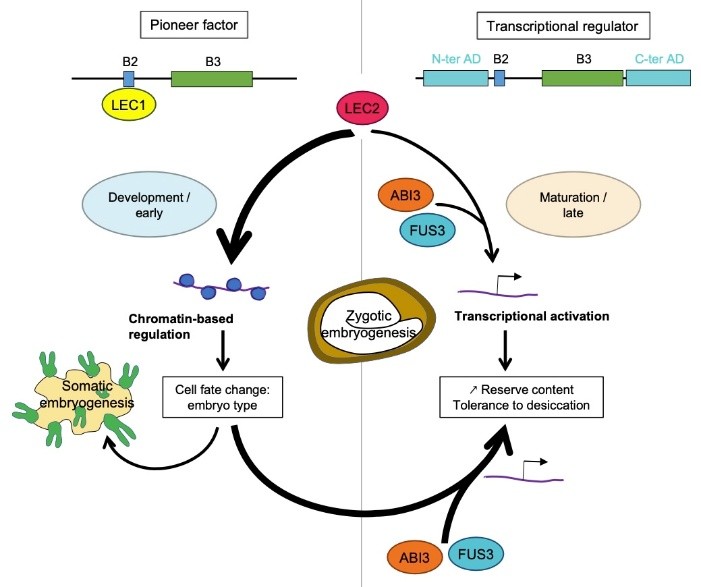
Proposed model of LEC2 action with and without its transcriptional activation domains
Research developed at the Institute Jean-Pierre Bourgin for Plant Sciences in collaboration.
In the model plant Arabidopsis thaliana, seed development is governed by a set of transcription factors known as LAFL, including LEAFY COTYLEDON 1 and 2 (LEC1 and LEC2). These master regulators are specifically expressed during the early stages of embryo development and are also involved in somatic embryogenesis, a process in which embryos can be generated from non-reproductive tissues. A structure–function analysis of the transcription factor LEC2 revealed the presence of several functional transcriptional activation domains in addition to its DNA-binding domain. Surprisingly, a modified version of LEC2 lacking these activation domains remained functional during seed development. This finding suggests that LEC2 may also activate gene expression indirectly, likely by acting within a protein complex that targets specific promoters without directly activating transcription itself.
This work opens new perspectives on the role of master regulators in the control of both zygotic and somatic embryogenesis. The identification of target genes whose regulation does not require direct transcriptional activation will need to be addressed in future studies.
In a sustainable context, the use of seeds, which serve as storage organs, for the production of molecules suited to a new carbon chemistry or of secondary metabolites with therapeutic and/or industrial potential is a major objective. Improving our understanding of the transcriptional regulation of these key regulatory factors may provide new opportunities to increase the accumulation of target compounds of agro-industrial value.
Proposed model of LEC2 action with and without its transcriptional activation domains
Research developed at the Institute Jean-Pierre Bourgin for Plant Sciences in collaboration.
Back

Figure caption: seeds of the lec2 mutant and wt plant (top right). Author: Bertrand Dubreucq
IJPB and BAP "Plant Biology and Breeding" INRAE Division Highlight
Contact: Bertrand Dubreucq, contact
Reference
Salaün C, Thévenin J, Edoura-Gaena A, Qiu Y, Burguet J, Miquel M, Lepiniec L, Dubreucq B. The characterization of the LEAFY COTYLEDON 2 activation domains reveals its conserved dual mode of action in flowering plants. Plant J. 2025 Aug;123(4):e70380. doi: 10.1111/tpj.70380
IJPB teams
> Seed - Development, Regulation, and Metabolism SEED-DREAM
Collaborating team
Max Planck Institute of Molecular Plant Physiology, Potsdam, Germany
Acknowlegment
The Plant Observatory - Cytology/Imaging plateform PO-Cyto
IJPB and BAP "Plant Biology and Breeding" INRAE Division Highlight
Contact: Bertrand Dubreucq, contact
Reference
Salaün C, Thévenin J, Edoura-Gaena A, Qiu Y, Burguet J, Miquel M, Lepiniec L, Dubreucq B. The characterization of the LEAFY COTYLEDON 2 activation domains reveals its conserved dual mode of action in flowering plants. Plant J. 2025 Aug;123(4):e70380. doi: 10.1111/tpj.70380
IJPB teams
> Seed - Development, Regulation, and Metabolism SEED-DREAM
> Modeling and Digital Imaging MiN
Collaborating team
Max Planck Institute of Molecular Plant Physiology, Potsdam, Germany
Acknowlegment
The Plant Observatory - Cytology/Imaging plateform PO-Cyto